
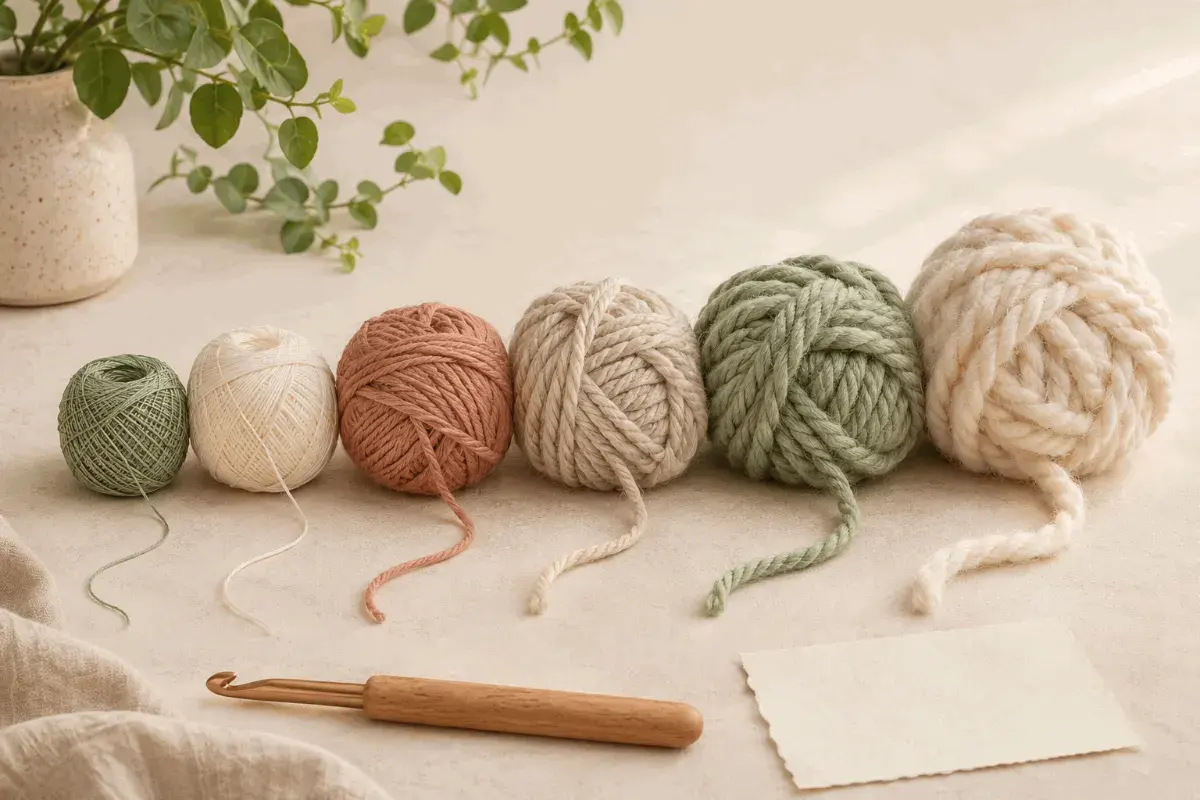
Illustration: a range of yarn textures and thicknesses, not eight calibrated categories.
Quick answer: Yarn weight describes the thickness of the strand, not the weight of the ball. The standard categories run from #0 Lace to #7 Jumbo. DK belongs to #3 Light, worsted and Aran sit within #4 Medium, and chunky commonly refers to #5 Bulky. Use the chart to narrow your choice, then check the pattern’s yarn, gauge and fabric before substituting.
All links checked: November 16, 2026. Every chart below links to its source: the Craft Yarn Council, the yarn companies or the designers.
Looking for something specific? Try our Pattern Finder to filter every pattern by skill level, time, sewing and hook size.
Your pattern calls for DK yarn, but the shop has light worsted, 8-ply and several balls marked 100 g. Which one should you buy?
Find the number and name in the chart first. Shopping for a substitute? Continue to the real-label comparison and the six-step substitution check. Working from leftover yarn? Use the WPI section and the quantity examples.
Yarn Weight Chart: Categories 0–7
The crochet hook ranges below follow the Craft Yarn Council’s Standard Yarn Weight System. They are general guidelines; your pattern may deliberately specify a different hook.
| Number | Category | Common yarn names | General crochet hook guidance |
|---|---|---|---|
| 0 | Lace | Lace; some crochet threads | Regular 2.25 mm, or a suitable steel hook for the thread |
| 1 | Super Fine | Sock, fingering, baby | 2.25–3.5 mm |
| 2 | Fine | Sport, baby | 3.5–4.5 mm |
| 3 | Light | DK, light worsted | 4.5–5.5 mm |
| 4 | Medium | Worsted, Afghan, Aran | 5.5–6.5 mm |
| 5 | Bulky | Chunky, craft, rug | 6.5–9 mm |
| 6 | Super Bulky | Super bulky, super chunky; some roving yarns | 9–15 mm |
| 7 | Jumbo | Jumbo; some roving yarns | 15 mm and larger |
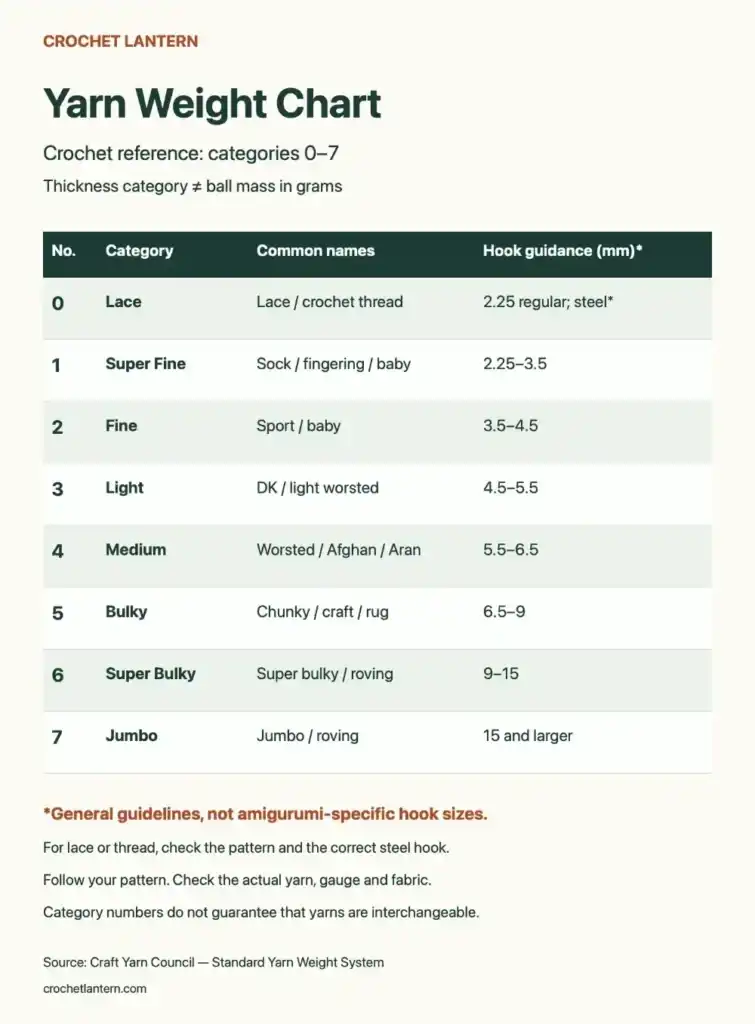
Lace projects often use larger hooks to create open fabric, so a single range is especially limiting here. Steel hook numbering also differs from regular hook sizing. Follow the thread and pattern specifications.
Read this as a reference, not a shopping formula. Category #4 does not mean a 4 mm hook. It also does not mean every category #4 yarn will behave alike.
Yarn Weight, Ball Weight and Length: Three Different Things
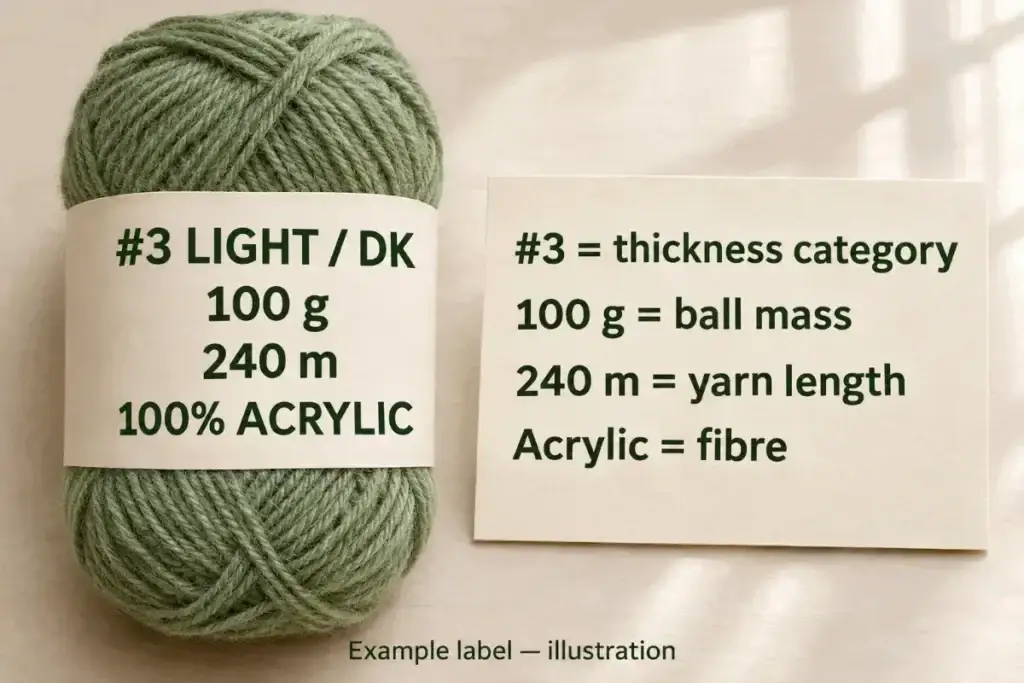
Imagine a label with the following information. This is a made-up teaching example, not a particular product.
| Label detail | Example | What it tells you |
|---|---|---|
| Yarn-weight category | #3 Light / DK | The strand’s thickness group |
| Net weight | 100 g | How much the ball weighs |
| Length | 240 m | How much yarn is in the ball |
| Fibre content | 100% acrylic | What the yarn is made from |
Two balls can both weigh 100 g and belong to different thickness categories. Two yarns can share a category and still have different lengths per ball.
The Craft Yarn Council’s label guide identifies the numbered symbol as a thickness category. For quantity calculations, Lion Brand recommends using yardage rather than assuming equal ball weights provide equal amounts.
Before leaving the shop, photograph the full label. Keep the product name, category, fibre, length, care information and colour details with your pattern notes.
Yarn Weight Conversion: US, UK and Australian Names
Regional names can help you search a shop’s catalogue, but they do not establish an exact substitute.
| Common US description | Common UK description | Common Australian / New Zealand description |
|---|---|---|
| Fingering / super fine | 4-ply | 4-ply |
| Sport / fine | Sport or 5-ply; terminology varies | 5-ply |
| DK / light worsted | DK | 8-ply |
| Worsted / medium | Often compared with Aran | Often 10-ply |
| Aran / medium | Aran | Often 10-ply |
| Bulky | Chunky | Often 12-ply |
| Super bulky | Super chunky | Often 14–16-ply |
These are common naming comparisons, not certified equivalences. LoveCrafts explains regional terminology, including the distinction between worsted and the often thicker Aran. WEBS also provides a regional conversion reference.
Does 8-ply mean eight visible strands?
Not necessarily when it is used as a regional weight name. Ply also describes the strands twisted together to construct yarn, but the thickness of those component strands can vary.
Treat “8-ply” on a regional shopping chart as a naming clue. Do not count a yarn’s visible strands and assume that identifies its weight category.
Is DK the same as worsted?
DK is generally classified as #3 Light, while worsted is #4 Medium. They are neighbouring categories, not automatic substitutes.
Suppose you have a DK cardigan pattern and a worsted yarn you love. Before buying a sweater quantity, make the pattern’s gauge sample. Decide whether you can reproduce both the measurements and the intended fabric. A matching colour does not solve a gauge mismatch.
Same Yarn Weight, Different Labels: Two Real Examples
Here are specifications published by two manufacturers, checked on November 16, 2026. These are label references, not results from a controlled comparison.
| Product | Category and fibre | Stated ball size | Manufacturer’s crochet gauge |
|---|---|---|---|
| Lion Brand 24/7 Cotton | #4 Medium; 100% mercerized cotton | 100 g / 170 m | 14 single crochet stitches and 19 rows over 4 inches, with 4 mm |
| Red Heart Super Saver — solids | #4 Medium; acrylic | 198 g / 333 m | 12 single crochet stitches and 15 rows over 4 inches, with 5.5 mm |
Both carry a #4 classification, but their stated gauge setups differ. Because the hook sizes also differ, this is not an experiment isolating the effect of yarn alone. It shows why reading only the category symbol leaves out useful information.
For Super Saver, the manufacturer lists different ball sizes for prints and other variants; the row above is specifically for solids. Check the actual shade and label before calculating quantities.
Read both labels, then test your alternative against the pattern’s instructions. Matching a manufacturer’s label gauge is not the same as matching your pattern’s gauge.
How to Choose a Substitute Yarn
The Craft Yarn Council cautions against treating weight categories as an interchangeability chart. Even matching gauge does not establish identical softness or drape.
Use this comparison before buying:
- Read the original yarn specification. Record the product, category, fibre blend, length per ball and pattern gauge.
- Choose a plausible alternative. Start with a comparable category and construction. Compare fibre properties and care needs, not just the shade.
- Check the required length. Work in either metres or yards throughout; do not mix the two units.
- Make the pattern’s sample. Use its specified stitch and follow its instructions for washing or finishing before measuring.
- Assess measurements and fabric together. A sample can measure correctly while feeling too stiff, too open or otherwise unsuitable for the project.
- Calculate the ball count. Use the alternative yarn’s length per ball, and allow for the sample and any project-specific extra needs.
WEBS’ yarn-substitution guide discusses gauge, fibre, quantity and fabric behaviour in more detail.
Worked example: why the category number is not enough
Here is a hypothetical comparison:
| Pattern setup | Your first sample | |
|---|---|---|
| Yarn category | #4 Medium | #4 Medium |
| Stitch gauge | 16 stitches per 10 cm | 14 stitches per 10 cm |
| Width across 40 stitches | 25 cm | About 28.6 cm |
The calculation is 40 ÷ 14 × 10 = 28.6 cm. Although both yarns are category #4, the sample’s stitch gauge would produce a wider 40-stitch section.
Try an appropriate hook adjustment and sample again. If the measurement only matches when the fabric becomes unsuitable, reconsider the yarn. This calculation illustrates stitch gauge; it does not predict a whole garment’s fit or replace checking row gauge and construction.
How Many Balls of Substitute Yarn Do You Need?
Use the length required by the pattern and the length supplied in each replacement ball:
Balls needed = required length ÷ length per ball, rounded up.
For a hypothetical project requiring 650 m, with replacement yarn supplying 180 m per ball:
650 ÷ 180 = 3.61 → buy at least 4 balls to cover that stated length.
Four balls provide 720 m. The 70 m difference is the remainder from rounding, not a guarantee that it will cover every swatch or alteration. Recalculate if you change the dimensions, stitch pattern, edging or colour allocation.
For colourwork, calculate each colour separately. Having enough total metres does not help if you run short of one shade.
Can you estimate how much is left in a used ball?
If you know the original label’s length and weight, a scale can give an estimate for that same yarn.
For example, a yarn labelled 200 m per 100 g, with 35 g of yarn remaining, gives:
200 ÷ 100 × 35 = approximately 70 m remaining.
Weigh the yarn alone. Remove packaging, and do not apply this ratio to another fibre or product. This is a proportional estimate, not a measurement of the strand’s exact length.
How to Identify Yarn Without a Label: WPI
Wraps per inch, or WPI, is a useful estimate when you have lost the label.
Following the Craft Yarn Council’s WPI method:
- Wrap the yarn around a pencil or another object with a consistent circumference.
- Place the wraps beside each other without overlapping or leaving large gaps. Avoid stretching or compressing the yarn.
- Count how many wraps occupy one inch. Repeat in several places.
- Compare the result with the reference ranges, then make a sample for your intended project.
| Category | Approximate wraps per inch |
|---|---|
| 0 Lace | 30–40+ |
| 1 Super Fine | 14–30 |
| 2 Fine | 12–18 |
| 3 Light | 11–15 |
| 4 Medium | 9–12 |
| 5 Bulky | 6–9 |
| 6 Super Bulky | 5–6 |
| 7 Jumbo | 1–4 |
The ranges overlap. A result of 12 WPI does not uniquely identify one category. Wrapping tension affects the result; WPI also cannot tell you the fibre content, care instructions or original product name.
Can You Hold Two Strands Together to Make Thicker Yarn?
Yes, but do not add the category numbers. Two strands of category #3 yarn do not automatically become category #6.
Lion Brand’s guidance on combining strands gives approximate examples, including two sport strands approaching worsted and two worsted strands approaching chunky to super bulky. The result still needs a gauge check.
Work the strands together as one, then assess the fabric your pattern requires.
Remember the quantity calculation: if your project needs 300 m worked with two strands held together, you need approximately 300 m of each strand, or 600 m combined, before any extra allowance. You are feeding two lengths through the project at once.
Which Yarn Weight Should You Choose for a Crochet Project?
If you are following a pattern, begin with its specified yarn. If you are choosing a project first, use these as starting ideas rather than fixed assignments.
| Your goal | Categories worth exploring | What to check before committing |
|---|---|---|
| Fine lace or delicate details | #0–#1 | Whether the stitch pattern and hook create the intended openness |
| Lightweight garments or small detailed projects | #1–#3 | Pattern gauge, finished measurements and fabric |
| Everyday hats, scarves or blankets | #3–#4 | The particular design’s thickness and drape |
| A thick blanket or substantial home accessory | #5–#7 | Finished bulk, fabric and the quantity required |
| A stuffed toy | Follow the specific design | Exact yarn, hook, density and separate parts |
These categories overlap in use: a blanket can be made in several weights. Choose a pattern that suits the yarn rather than assuming the category alone determines a successful result.
If the instructions still feel confusing, start with our guide to reading crochet patterns before changing the materials.
Choosing Yarn Weight for Amigurumi
General hook guidance and an amigurumi pattern can differ. The published toy’s specified yarn, hook and fabric take priority over a generic chart.
For example, Sweet Softies’ Peyton the Polar Bear specifies a 5 mm hook with Copenhagen super bulky yarn. The Loopy Lamb’s Jumbo Snowman specifies 8 mm with Bernat Blanket. Both yarns are category #6, but the designs use different setups.
For more examples and checks for stuffing gaps, use our amigurumi crochet hook size guide.
If you change from a smooth yarn to a plush one, check the new fabric, dimensions and separate parts rather than assuming the weight number preserves the original result. These are designer specifications, not Crochet Lantern test results.
Yarn Weight Questions
What does DK mean, and what number is it?
DK stands for double knitting. As a yarn-weight description, it belongs to #3 Light and is often called 8-ply in Australian and New Zealand naming. It does not mean you must crochet with two strands.
Is sport weight yarn the same as DK?
Sport is generally #2 Fine; DK is #3 Light. Start with the weight named by your pattern, and check a sample before substituting one for the other.
What is light worsted weight yarn?
Light worsted is a name used in #3 Light alongside DK. Check the word “light”: ordinary worsted is grouped in #4 Medium, so these labels should not be treated as identical.
Is 100 g yarn DK or worsted?
The ball’s mass does not identify its thickness. Look for the category or weight name on the label; if it is missing, investigate the product details or use WPI as an estimate.
Is Aran the same as worsted?
Both commonly sit within #4 Medium, but Aran is often thicker. Use the pattern’s gauge and intended fabric to assess a substitution.
Does baby yarn always mean one weight?
No. The standard chart uses “baby” in more than one category. Check the actual number or specification rather than relying on the marketing name.
Is chenille always super bulky?
Treat chenille as a yarn description, not a category number. Check the specific product’s stated weight and the designer’s materials list.
Can the right hook fix any yarn substitution?
A different hook may help you reach gauge, but it does not change the yarn’s fibre composition or guarantee the desired fabric. Reassess the yarn if the sample is unsuitable.
Are knitting gauge and crochet gauge interchangeable?
No. Check which craft, stitch and measurement the label or pattern describes. Use your crochet pattern’s sample instructions rather than comparing it with a knitting gauge figure.
Four Yarn-Weight Mistakes to Catch Before You Start
- Buying equal grams instead of enough length. Recalculate from the replacement ball’s metres or yards.
- Treating the same category as an exact match. Compare a sample with the pattern’s measurements and assess the fabric too.
- Comparing different gauge tests. Keep the craft, stitch, measurement area and finishing instructions consistent with the pattern.
- Adding weight numbers when combining strands. Sample the combined yarn; category numbers are labels, not quantities to add.
For problems during a project, our common crochet mistakes guide offers additional checks alongside the original pattern instructions.
Before You Buy: A Short Yarn Checklist
Save the chart, then record the yarn category, full product name, fibre, required length and pattern gauge. If you are substituting, make the sample before committing to the full quantity whenever practical.
Need help with the instructions? Our guide to reading crochet patterns explains how to interpret pattern information. Once your yarn choice is settled, explore our Pattern Finder for your next project.
Sources and editorial scope
This guide uses the linked Craft Yarn Council references, yarn-company guidance and designer specifications. Source: Craft Yarn Council’s www.YarnStandards.com.
The worked shopping and gauge calculations are hypothetical teaching examples. The two product-label rows are separately attributed manufacturer specifications. They are not measurements from Crochet Lantern hands-on tests. Regional names and WPI ranges help narrow choices; they do not certify that two yarns are interchangeable.
Browse all our crochet size charts, or see every collection in learn-to-crochet guides.
Leave a Reply